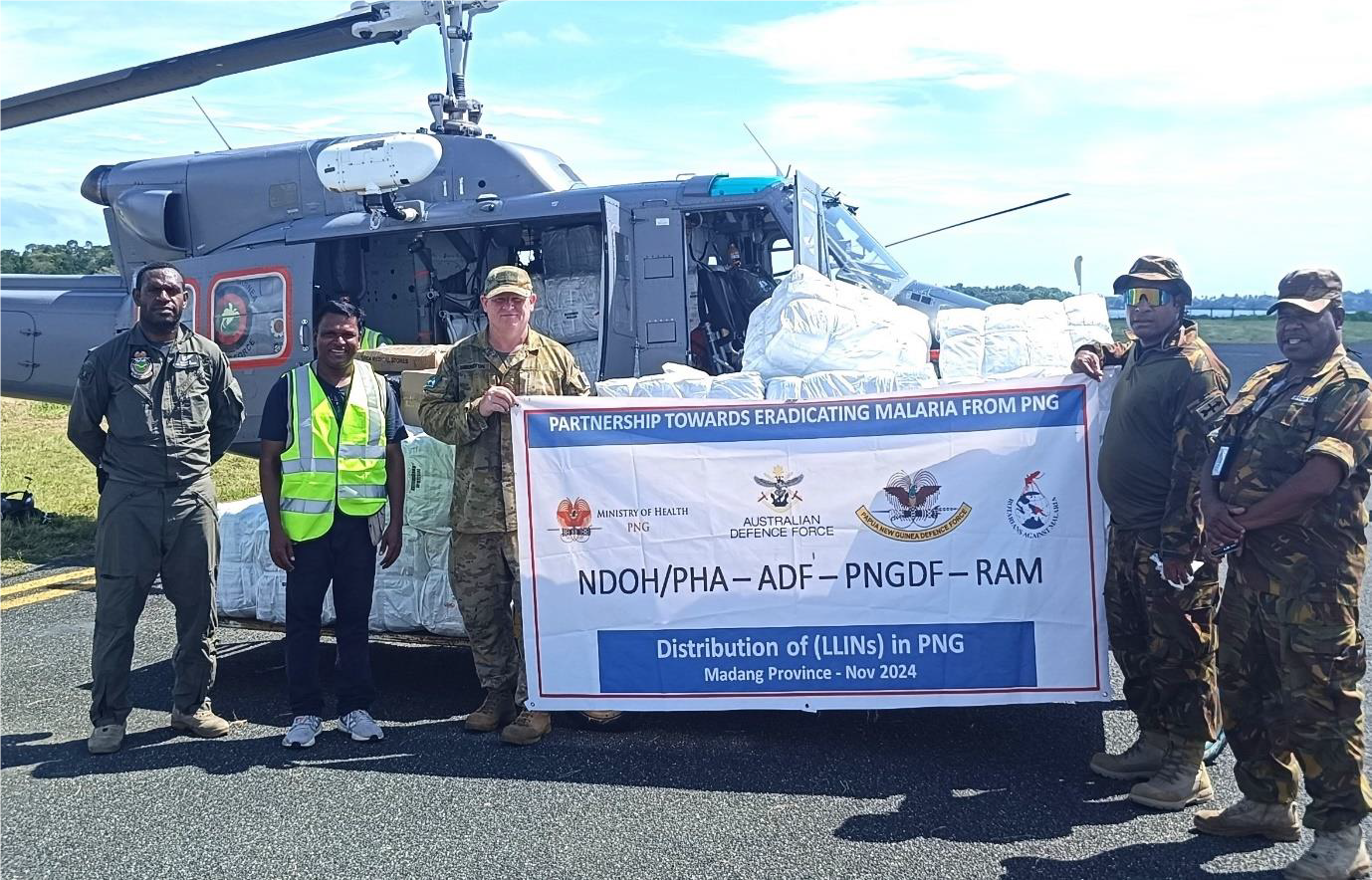
This report documents a successful collaborative malaria intervention in Madang Province, involving strategic partnerships to improve health logistics and outcomes.
Overview and Background Malaria remains a major health challenge in Papua New Guinea, especially in remote communities with limited access to prevention tools. Traditional distribution methods faced logistical issues, high costs, and delays, hindering effective coverage. To address this, a partnership was formed among the NDOH, PNGDF, ADF, and RAM to leverage military logistics and air support for rapid LLIN distribution.
Partnership Framework The collaboration defined roles: NDOH provided oversight and policy integration; PNGDF supplied ground personnel, logistics, and security; ADF deployed helicopters and crew; RAM managed procurement, community mobilization, and distribution. This joint effort aimed to overcome access barriers efficiently.
Operational Execution Pre-deployment planning included route mapping and risk assessment, with commodities pre-positioned. The active phase lasted 20 days, utilizing two ADF helicopters, 150 flight hours, and personnel from all partners. The operation delivered 68,000 LLINs, malaria medications, and approximately 60 tons of cargo to 13 remote health facilities.
Key Outcomes The mission was completed in 20 days—significantly faster than conventional methods—saving over PGK 1.5 million. It protected an estimated 45,000 individuals, reducing malaria transmission in high-burden areas. The model demonstrated high efficiency, cost-effectiveness, and public health impact.
Lessons and Recommendations The success advocates formalizing the partnership through a Memorandum of Understanding, integrating this model into national strategies for hard-to-reach areas, and replicating it in other provinces such as Western Province and Southern Highlands to enhance nationwide malaria control efforts.